This project began with an interest in mechanical reproduction as a system of transfer. How images move from one form to another, and what is lost or preserved in that movement. Initially, I approached reproduction through a conventional design lens: reproduction was understood as a process of accuracy, fidelity, and consistency, where deviation signalled failure. My assumption was that errors in print were technical problems to be corrected, and that the role of the designer was to minimise friction in order to achieve clarity and control.
Through sustained engagement with Risograph printing, this position gradually shifted. Rather than functioning as a neutral reproductive tool, the Riso revealed itself as a site of friction where machine, material, and image resist full alignment. My practice moved from attempting to eliminate instability to working with it as a generative condition.
The Riso printer occupies a hybrid space between analogue and digital systems. Although it relies on scanned digital files, its output is governed by mechanical contact: ink pushed through stencils, paper pulled against a rotating drum, colours printed sequentially rather than fused. This process consistently produced misregistration, uneven ink density, overprints, and colour shifts even when the same file and settings were used. I learned that preventing these deviations required significant configuration and control. Stability, rather than being inherent, had to be actively enforced. This revealed reproduction not as a seamless system, but as one that constantly resists standardisation.
My process involved repeatedly printing the same source image while varying conditions such as paper type, print order, and alignment. Printing on used and crumpled paper intensified this resistance. The paper surface asserted its own history through color, fibres and previously printed matter, disrupting the image’s legibility. The image could not fully overwrite what was already there. The substrate no longer behaved as a neutral ground, it became an active participant. This materially grounded process shifted my understanding of reproduction away from visual sameness and toward material encounter.
What refuses to stabilise is not the image itself, but the assumption that stability is the natural state of reproduction. What we understand as stability is a conventional design ideal rooted in clarity, control, and standardisation. In contrast, the destabilisation of the image emerges as friction: a visible record of resistance between machine, material, and process. This friction interrupts seamless legibility, forcing a cognitive pause and reflection. Rather than signalling failure, these moments of instability carry traces of history, use, and material encounter, allowing the image to communicate authenticity through its imperfections and accumulated transformations.
Walter Benjamin’s writing on mechanical reproduction helped reframe this shift in position. Rather than mourning the loss of the “original,” my experience aligned more closely with Benjamin’s observation that reproduction transforms how artworks exist and are encountered (Benjamin, 1969). In my process, the original analogue work was quickly de-centred. It moved from paper to scan, from scan to JPEG, from JPEG to PDF, and finally into the printer. Each translation detached the image from the conditions of its making. Yet meaning accumulated not through preservation, but through repetition and degradation. The value of the work no longer resided in an authentic original, but in the visible traces of its reproduction.
This understanding was further sharpened through Hito Steyerl’s notion of the “poor image,” which frames degradation, compression, and instability as evidence of circulation rather than loss (Steyerl, 2012). The Riso prints function similarly: misalignment, bleed, and uneven colour are not defects but records of movement through systems. My position shifted from viewing clarity as communicative authority to recognising friction as a form of knowledge: one that reveals the conditions under which images are produced and reproduced.
Finally, the logic of Conditional Design resonated directly with my studio process. Rather than treating the Riso as a tool to be mastered, I began to work with it as a system of conditions that produce variable outcomes. Repeating the same input did not guarantee the same result; instead, each iteration exposed how control is distributed across machine behaviour, material response, and process decisions (Conditional Design, 2013). This reframed authorship as partial and situated, rather than singular or total.
Through this process, my view of reproduction fundamentally changed. Reproduction is not a mechanism for preserving clarity, but it can be used as a site where friction accumulates, meaning shifts, and images are continually re-authored through resistance. The studio became a space to remain with instability rather than resolve it, allowing reproduction itself to be examined as an active, material, and contested process.
References
Benjamin, W. (1969) The Work of Art in the Age of Mechanical Reproduction. New York: Schocken Books.
Steyerl, H. (2012) ‘In Defense of the Poor Image’, in The Wretched of the Screen. Berlin: Sternberg Press.
Conditional Design (2013) Conditional Design Workbook. Amsterdam: Valiz.
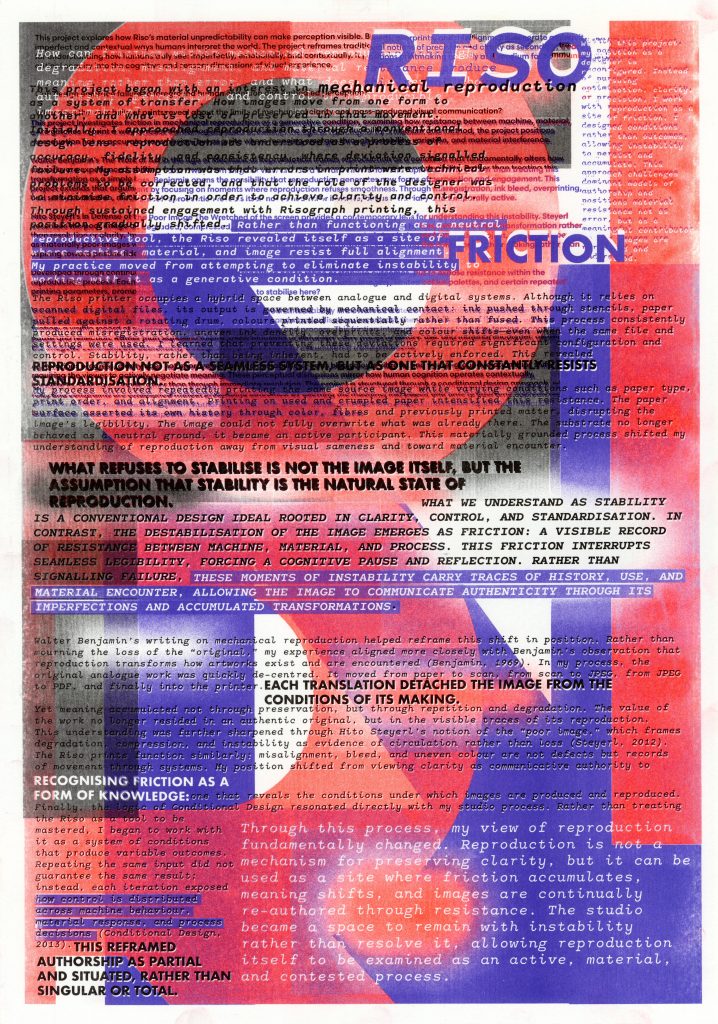
Text Renders in Riso

Text render in Riso
On brown paper, 120 gsm
Text render in Riso
On Yellow colored paper, 200 gsm
